
GrowinAgri

Ankit Kumar

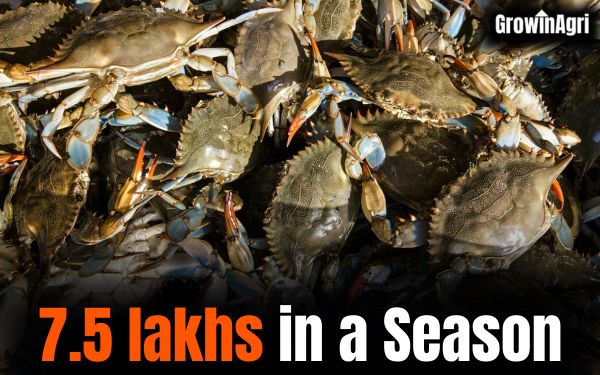
Mayur Ji Make 7.5 lakhs in a Season with Crab Farming

Crab farming is an emerging business in India. Today we will tell the story of one such successful farmer, Mayur Jagdale, who lives in a small village in Sangli district of Maharashtra. He adopted crab farming instead of traditional farming and is earning lakhs.

Inspiration from the Internet

Mayur found out that there is a huge market demand for crabs which are naturally found in rivers and ponds. Then he searched on the Internet and found out that the black mud crab (Scylla serrata) farming technique was first started in Tamil Nadu in 1984, and its research station is also there. He came to know that black mud crab farming is possible; it can be started in less space and at low cost.

Big profit in small tank!

Mayur constructed a tank of 25×25 feet on the land near his house, the width of which was kept at 6.5 feet. He prepared it with several layers to give a natural look to the crab:

  • First layer: Use of small stones;
  • Second layer: Use of black soil;
  • Third layer: Use of Murup soil;
  • Fourth layer: Use of red soil;
  • Fifth layer: river sand;
  • Sixth layer: Use of black stones where the crab can hide.

Apart from this, to prevent the crabs from coming out of the tank, he fixed tiles on the walls and covered it with a net to protect it from birds.

From oxygen supply to coolness

He set up an oxygen supplier to generate oxygen in the tank, used a fogger system for a cool environment in summers and planned water drainage to maintain the quality of water.

Low cost, high profit

Mayur says that the cost of setting up this entire setup was around 2 to 2.5 lakhs, which is called “one-time investment”. The labour cost in this farming is negligible. He manages his farm himself and gives feeding only twice a week.

Better growth with the right diet!

Mayur ji feeds boiled waste chicken and fish to the crabs so that the problem of infection is reduced and the water does not smell. The amount of ammonia increases from the excreta of the crab, due to which the crab starts dying. To avoid this problem, Mayur drains the water twice a week and uses a fogger system to maintain oxygen.

Identification and life cycle of crab!

Mayur puts 80 kg of female crabs and 20 kg of male crabs in his tank, which grows to 3.5 to 4 tonnes of crabs in 5 to 6 months. He said that a crab lays 500-600 seeds per female crab.

The life cycle of every male crab is 3 years, and that of a female crab is 2 to 2.5 years. The stomach of a male is in an A-shape, and the stomach of a female is in a U-shape.

Huge demand in the market, high price!

Mayur says that he gets more profit by selling it in the months of January to February; at this time there is a shortage of crabs in the market. In the local market of Sangli, its price goes up to Rs 250 to 300 per kg, while in other big cities like Pune and Mumbai, it goes up to Rs 500 per kg. He produces about 3.5 tonnes to 4 tonnes of crab in a season and earns more than 7.5 lakhs in a season.

The journey started from the village and became an example for millions!

This journey of Mayur Jagdale is an inspiration for farmers and youth. Crab farming is a low-cost and high-profit business. New hopes can be discovered by combining innovation and modern techniques in our agricultural fields.
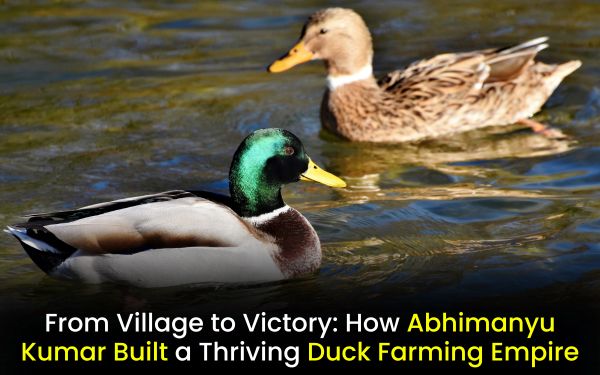
From Village to Victory: How Abhimanyu Kumar Built a Thriving Duck Farming Empire!

From Village to Victory: How Abhimanyu Kumar Built a Thriving Duck Farming Empire!

Abhimanyu Kumar, a resident of Simraha village in Muzaffarpur district of Bihar, has established a successful start-up in the field of duck farming. His start-up has been a source of inspiration for the youth for the last 2 years. He is earning lakhs of rupees every month from this farm.

Which breeds are making this farm special?

Abhimanyu raises two excellent breeds of ducks on his farm – Indian Runner, whose total number is more than 1500, and Khaki Campbell, whose total number is 1000.

Small land, big business – know how!

Abhimanyu ji says that there is no need for much land or a lot of money to do duck farming. Interested farmers can also start it according to their capital and land. He has suggested starting with 500 ducks.

  • For this, 3 to 4 kattha of land will be required.
  • A pond will have to be dug in 1 kattha (1361 sq. ft.) where the ducks can get a natural environment.
  • It takes ₹50,000 to ₹60,000 to set up a simple farm.

Less expense, more profit – know how!

Abhmanyu says the pre-starter feed for the first week is a little expensive but is necessary. For the first 4-5 months, the feed cost comes to 15-20 thousand rupees per month. If he is to be believed, then it comes to 2 to 2.5 lakh rupees to establish the farm and till the egg laying stage. For the first 35-40 days, the chicks need proper temperature and care, which is called brooding. When the brooding period is over, the ducks are ready to get into the water.

Bumper production of eggs – Which breed lays more eggs?

According to Abhimanyu, the Indian Runner breed lays 300 eggs in a year, while the Khaki Campbell lays 360 eggs in a year.

Problem of selling eggs? Here is a smart solution!

Farmers who have problems selling eggs buy them and put them in their 40-thousand-capacity hatchery. They take the order of chicks 10 days in advance. They connect with new farmers by selling the chicks and keep visiting their farms and guiding them till the egg-laying stage (about 4 to 5 months).

Fear of disease? Here is an easy solution!

Abhimanyu said that the risk of diseases is very low in duck farming. It is necessary to give calcium, liver tonic and antibiotics at the time of brooding. He mentioned a “Lysoda injection”, which is given once a month.

Correct design of the pond – what should be the water level?

He said that ducks can live even in less water; a water layer of 1 to 2 feet is suitable. Soil starts falling due to adding more water, so it is important to maintain balance. He has forbidden fish farming along with duck farming.

Correct diet – the secret of profit!

He said that pre-starter feed is given for the first 7 days of the beginning, then a pre-starter of lesser cost for 1 month. After one month, grower feed is given, which is given in a full quantity of grower feed in the morning and half the quantity of grower feed + paddy in the evening.

The ducks which lay eggs eat 120g of feed daily.

The correct ratio of males and females is important!

He said that if there are 1000 ducks, then it is necessary to have 150-200 male ducks in it.

A new path of success for young farmers!

This is a boon for the youth; it can give huge profit at a low cost. Leaving the job and living in the village is an inspiration to start a start-up worth lakhs. This success story of Abhimanyu Kumar has become a source of inspiration for lakhs of youth.

Husband Wife Farm Generate lakhs from moringa farming

Husband Wife Farm Generate lakhs from Moringa Farming

The husband-wife duo (Jitendera Mann and Sarla Mann), residents of a small village, Mehmudpur, in Haryana’s Sonipat district, through their hard work and wisdom, have taken their moringa farming business to such heights as the Burj Khalifa building, and they are earning lakhs of rupees. Their success story is becoming an inspiration for other farmers and young youth.

How the Idea of Moringa Farming Sprouted?

Moringa oleifera, which is a scientific name, is known in India by the names of drumstick, sigru, shevga, shegat, drumstick, etc.

When Jitendra was working in Madras, one of his friends told him about the medicinal properties of moringa. From there, a seed of starting this business germinated in his mind. Then, he has been doing organic moringa farming for more than 5 years.

How Soil & Climate Helped Them

Jitendra said that Haryana soil, which is of alluvial and loamy type, is considered best for this. He also said that the medicinal properties of Moringa depend on the quality of the soil. Luxuriant growth occurs when the pH value of the soil is 6.5-8 and the temperature is 25-30°C.

Initial Challenges for Crop Health

In the beginning, he did not have much knowledge about planting distance. Later, he contacted some farmers of Gujarat, and then he came to know that the distance between plant to plant should be 1 foot and the distance between row to row should be 4 feet.

Planting plants with this method increases the production of leaves. Water is required less in Moringa farming. Jitendra uses flood irrigation during his farming, but he has suggested promoting drip irrigation.

How R&D Helped Them

During R&D, Sarla observed that drying the leaves in a dark room, away from exposure to sunlight or dust/mud, does not compromise the quality of the leaves.

Processing Steps

  1. She said that after harvesting the leaves, she washes them thoroughly with water so that the risk of diseases like ulcers is reduced.
  2. Then all the leaves are dried separately without any overlap in a dark room for 10-12 hours till they become crunchy dry.
  3. When the leaves are dry, she separates the stalk from the leaves so that pregnant women can also consume it.
  4. Then she converts these dried leaves into a coarse powder and then packs it carefully so that it does not spoil for a long time.

Selection of Variety and Seed Sowing

When Jitendra Mann was working in Chennai, he brought seeds of Moringa oleifera from there, which is an indigenous desi variety. He said that its results are very good when planted in a forest concept; leaves start coming after 2-3 months of planting.

Challenges and Marketing Strategies

Sarla Mann said that there is a huge demand for moringa leaves in the international market, but companies do not pay a fair price for it. They produce only as per the order.

Their smart marketing strategies

  1. To give an identity to their product, they created a channel on YouTube named “Husband Wife Farm,” where they provided information related to their product.
  2. They created their own website through which they could connect with the customers directly.
  3. Because of its medicinal properties, they presented it as a premium product.
  4. They won the trust of the customers with good strategy and understanding. They succeeded in giving a distinct identity to their product.

Conclusion

The success story of Jitendra Mann and Sarla Mann shows that if hard work, passion, and good strategy are used, then you can earn millions from agriculture. Organic Moringa farming not only helps financially, but it also keeps the health of our neighbors living around us better.

Their success has become an inspiration for every youth who wants to start their own start-up.