
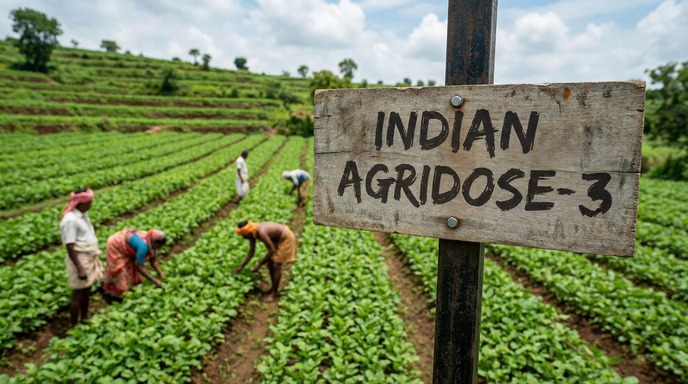
India’s agriculture sector is standing at a powerful crossroads—where climate stress, innovation, policy reform and global market access are converging faster than ever before.
This edition of Indian AgriDose captures that momentum.
From the world’s first three-way pearl millet hybrid designed for India’s harsh drylands, to smart fishing infrastructure in the Andaman Islands, new agri-biotech delivery systems, digital farmer onboarding, export wins, and policy advocacy—this week’s developments show one clear truth:
India is not just adapting to climate change—it is engineering resilience.
Whether you are a farmer, agribusiness leader, policymaker, investor or startup founder, these stories highlight where India’s agri economy is heading—and where the next opportunities lie.
World’s First Three-Way Pearl Millet Hybrid RHB 273 Launched for India’s Drought-Prone Regions
ICRISAT, in partnership with ICAR and RARI, has announced the release of the world’s first three-way pearl millet hybrid, RHB 273, designed specifically for dryland regions of Rajasthan, Gujarat, and Haryana. Notified for A1 zones with rainfall below 400 mm, the hybrid integrates high yield, drought tolerance, disease resistance, and superior fodder quality through a three-parent breeding approach.
After extensive multi-location trials across 30 sites, RHB 273 recorded an average yield of around 2,230 kg/ha—up to 27% higher than regional varieties and nearly 28% more than HHB 67 Improved. This dual-purpose hybrid is expected to strengthen food, nutrition, and fodder security in some of India’s most climate-stressed farming regions.
CropLife India Warns on Un-Authorised Pesticide Sales via E-Commerce
CropLife India has raised concerns over the rising sale of Un-Authorised and spurious pesticides through e-commerce platforms, calling for stronger regulation and enforcement. At its national conference in New Delhi, the association urged a joint government–industry framework to ensure platform accountability, traceability and farmer safety.
Officials highlighted that basic compliance checks by online platforms are inadequate for hazardous products like pesticides. CropLife India noted regulatory gaps under existing laws and the Draft Pesticides Management Bill, 2025, especially for inventory-based e-commerce models. The association emphasized that regulated digital enablement is essential to protect farmers, food security and consumer trust.
Mahindra Tractors Launches Tricolour-Inspired Limited-Edition Yuvo Tech+ 585 DI
Mahindra Tractors has unveiled a Tricolour-inspired Limited-Edition Yuvo Tech+ 585 DI 4WD to mark Republic Day 2026, celebrating national pride and Indian agriculture. Offered in restricted numbers, the tractor comes in Metallic Orange, Everest White and Metallic Green shades inspired by the Indian flag.
Based on Mahindra’s popular Yuvo Tech+ platform, the limited edition combines visual appeal with strong performance, featuring a 45.4 HP engine, 2000 kg lift capacity and advanced transmission options. The Metallic Green variant includes exclusive accessories, and the tractors will be available at select dealerships from January 26, 2026.
ICRISAT Signs MoU with Odisha Government to Support Drought Mitigation
ICRISAT has signed a Memorandum of Understanding with the Government of Odisha under the National Drought Mitigation Programme, reinforcing its role in promoting climate-resilient agriculture in the state. The MoU was formalised during Krushi Odisha 2026, a flagship event organised by the Department of Agriculture & Farmers’ Empowerment.
The collaboration aims to strengthen the Odisha Agriculture Drought Mitigation Programme through integrated, systems-based approaches focused on resilience, nutrition and farmer livelihoods. The partnership brings together state agencies, national and international research institutions to support sustainable agricultural transformation and long-term drought preparedness in Odisha.
ICAR Develops Biocapsule Technology for Efficient Delivery of Beneficial Microbes
ICAR–Indian Institute of Spices Research, Kozhikode has developed and commercialised a novel biocapsule technology for storing and delivering agriculturally important microbes, including PGPR, Trichoderma and nutrient solubilizers. The gelatin-based capsules keep microbes in an inactive state and can be activated by dissolving in water before seed, seedling or soil application.
The eco-friendly technology ensures precise delivery, high microbial population, long shelf life and easy storage at normal temperatures. Licensed to startups such as CodaguAgritech and SRT Agro Science, over 30,000 capsules have already been sold across multiple Indian states, supporting sustainable and cost-effective agri-biological use.
ACFI Urges Government to Cut Pesticide Import Duty and GST Ahead of Union Budget 2026
The Agro Chem Federation of India (ACFI) has requested the government to reduce the import duty on pesticides from 10% to 5% in the Union Budget 2026 to lower cultivation costs and improve farmer access to modern crop protection technologies. The federation also called for rationalisation of GST on pesticides, which is currently 18%, compared to 5% on fertilisers.
ACFI said the tax disparity increases the cost burden on small and marginal farmers, who make up over 85% of India’s farming community. With changing climate and cropping patterns, access to newer molecules has become critical for crop protection. The industry urged the government to treat pesticides as essential inputs and align their tax rates with fertilisers to support productivity and farm incomes.
Madhya Pradesh Approves 100-Acre Flower Cluster in Ujjain Ahead of Simhastha 2028
The Madhya Pradesh government has approved a 100-acre commercial flower cultivation cluster in Ujjain to ensure steady floral supply for Simhastha Kumbh Mela 2028 and the city’s major temples. Implemented by the state Horticulture Department, the project aims to modernise high-value agriculture and create sustainable income for local farmers. The cluster will promote scientific cultivation of roses, marigolds, gerberas, tuberose, chrysanthemums, and gladiolus. Localised production is expected to cut transport costs, reduce post-harvest losses, and strengthen market linkages. The initiative aligns religious tourism demand with long-term agribusiness growth in the region.
Centre Sanctions ₹199.24 Cr Smart Fishing Harbour at Mayabunder in Andaman & Nicobar
The Ministry of Fisheries has approved ₹199.24 crore to develop a Smart and Integrated Fishing Harbour at Mayabunder in the Andaman & Nicobar Islands under the Pradhan Mantri Matsya Sampada Yojana. Built in line with the Blue Port Initiative, the harbour will feature IoT-enabled systems, safe berthing for 430 vessels, digital traceability, energy-efficient operations, and sustainable fish-handling infrastructure. It will handle nearly 9,900 tonnes of fish annually while strengthening livelihoods and curbing illegal fishing. The project supports the Islands’ growing tuna cluster and value chain development. It is a key step toward India’s goal of ₹1 lakh crore seafood exports by 2030–31.
Madhya Pradesh Opens Straw Reaper Subsidy Applications on e-Agriculture Portal Until February 2
The Madhya Pradesh government has opened applications for purchasing straw reaper machines under a subsidy scheme to promote eco-friendly crop residue management. Farmers can apply online through the e-Agriculture Farm Machinery Subsidy Portal from January 22 to February 2, 2026. Applicants must submit a ₹10,000 demand draft from their own bank account in favour of the concerned district’s Assistant Agricultural Engineer, failing which the application will be invalid. Required documents include land records (Khasra B-1), Aadhaar card, bank passbook, tractor RC, and caste certificate for SC/ST farmers.
Centre Approves Tur Procurement in Maharashtra with ₹2,696 Crore MSP Support
The Government of India has approved the procurement of 3.37 lakh metric tonnes of tur (pigeon pea) from Maharashtra under the Price Support Scheme, involving an MSP outlay of around ₹2,696 crore. The decision was taken at a high-level meeting chaired by Union Agriculture Minister Shivraj Singh Chouhan, with coordination between the Centre, Maharashtra government, NAFED, and NCCF. The procurement will be carried out directly from farmers to reduce intermediaries and ensure MSP benefits reach genuine producers. Officials have been directed to expand procurement centres, adopt transparent digital systems, and prioritise farmer convenience for smooth and efficient operations.
Bihar Government Offers 50% Subsidy to Start Nursery Businesses
Bihar’s government is providing a major opportunity for farmers and youth to start nursery businesses under the Agriculture & Forestry Scheme, offering up to 50% subsidy on setup costs. The scheme supports both new nurseries and production of forestry-related plants like Gumhar, Semal, Malawar Neem, and other quality saplings. For small nurseries on half a hectare, the total cost is ₹10 lakh, with a ₹5 lakh grant, while existing nurseries producing forestry plants can get ₹2.5 lakh subsidy on a ₹5 lakh unit cost. Applications are open to all eligible residents, with selection on a first-come, first-served basis, and SC/ST applicants must submit caste certificates. Interested candidates can apply online via horticulture.bihar.gov.in or the Bihar Agriculture App, and beneficiaries must submit geo-tagged selfies and site inspection certificates before and after project completion.
Bihar Launches Mission-Mode Farmer Registration Drive from 2–6 February, Rewards for Top-Performing Districts
Bihar government will conduct a mission-mode farmer registration drive under the AgriStack project from 2nd to 6th February to connect maximum farmers to the system. Farmers will not be charged any fees for registration, and top-performing districts will receive government incentives. So far, around 29.55 lakh farmers have been issued farmer IDs, and e-KYC has been completed for over 67 lakh farmers, while the state has approximately 75 lakh beneficiaries under the PM-Kisan scheme. Districts achieving 50% registration of PM-Kisan beneficiaries will receive ₹1.5 lakh, while those achieving 35% will get ₹50,000. The initiative aims to improve access to agricultural schemes in a transparent, timely, and efficient manner, with Bihar’s model earning national recognition as a best practice during a recent workshop by the Ministry of Agriculture and Farmer Welfare.
Odisha Exports Fresh Strawberries to London, Marks Entry into Global Markets
Odisha has achieved a major agri-export milestone with the first-ever shipment of 51 kg of fresh strawberries from Dhenkanal to London, enabling farmers to earn nearly 50% higher prices than local markets. The export was led by Saptasajya Agro Producer Company Limited, showcasing the role of FPOs in producing export-quality horticultural crops.
Supported by the Directorate of Horticulture under the PSFPO project, along with APEDA, WTC and OLM, the initiative highlights strong institutional collaboration. This landmark export positions Odisha as an emerging supplier of high-value horticultural produce in global markets and opens new income opportunities for farmers.
India’s Pulses Imports Expected to Fall 30% in FY26
India’s pulses imports are projected to decline by around 30% to 5 million tonnes in FY26, down from 7.3 million tonnes in the previous fiscal year. The reduction is attributed to higher carry-forward stocks, a weakening rupee, and the imposition of a 30% duty on yellow peas. Bimal Kothari, Chairman of the India Pulses & Grains Association (IPGA), noted that significant quantities imported last year are still in stock, contributing to lower import requirements this year. Commerce Ministry quick estimates also reflect a 33% decline in import value during April–December FY26, totaling $2.525 billion compared to $3.788 billion in the same period last year. The drop signals a tighter import demand amid domestic stock availability and policy measures.
Editor’s Note
Dear Readers,
As India moves deeper into 2026, agriculture is no longer just about production—it is about survival, sustainability, and scale.
This edition reflects a sector that is:
- Innovating (biocapsules, drought-resilient hybrids, smart harbours),
- Reforming (MSP procurement, digital farmer IDs, regulatory push on e-commerce pesticides),
- Expanding (global strawberry exports, flower clusters, fisheries value chains), and
- Advocating (tax reforms, fair digital markets, input access).
What stands out most is the shift from fragmented solutions to systems-based agriculture—where technology, policy, climate resilience, and farmer income are being addressed together.
At Indian AgriDose, our mission is to bring you not just news—but signals of change. Signals that help you understand where India’s agri economy is heading, and how you can be part of that transformation.